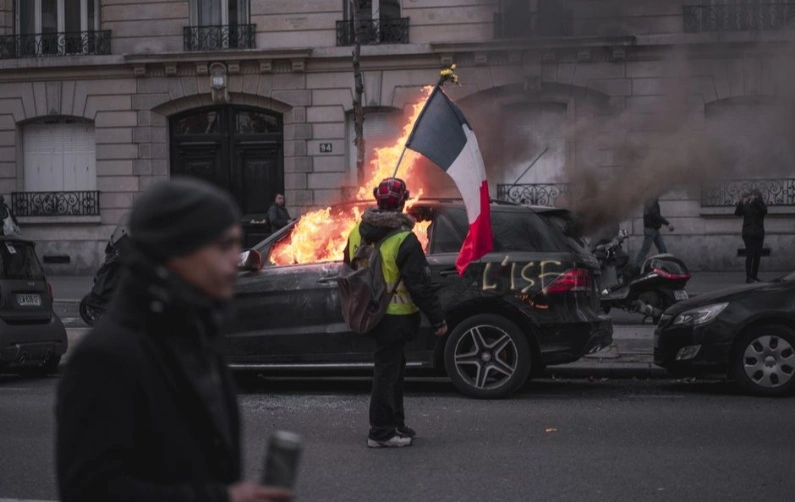
Protests erupt across Europe amid various grievances
Section: News
Fashion is often seen as a superficial art, as an industry of just creativity, trends and personal style. But in reality is deeply embedded in the structures that organize global society. It is not just about clothing; it is about power: who gets to be visible, who is valued, who is exploited, and who decides what "normal" looks like.
To understand fashion as political is to understand that every garment is part of a global system that connects bodies, economies, and ideologies across borders.
At the most immediate level, fashion shapes how people are read in everyday life. Clothing functions as a visual code that signals class, gender, ethnicity, and social status before a single word is spoken.
A suit is often interpreted as authority and credibility. Casual clothing may be read as carelessness or lack of discipline. In many contexts, the same body can shift from "respectable" to "suspicious" purely based on clothing. This is not about aesthetics, it is about social classification.
The work of Judith Butler helps explain this logic: identity, especially gender, is not an inner truth expressed outwardly, but something performed through repeated social acts. Clothing is one of the most visible tools through which these performances are enforced and regulated. Dress codes in schools, workplaces, and public institutions formalize these expectations, turning cultural norms into rules with consequences.
Beyond appearance and symbolism, fashion is one of the clearest examples of global economic inequality.
The modern garment industry depends on a geographically fragmented supply chain. Design, branding, and retail are concentrated in wealthy countries, while production is outsourced to regions where labor is cheaper and protections are weaker. This structure is not accidental, it is the economic foundation of fast fashion.
The result is a hidden transfer of cost. The low price of clothing in global consumer markets is made possible by underpaid labor, unsafe working conditions, and also the environmental costs of it (Textile production causes 3 to 8 percent of global greenhouse gas emissions). Workers in garment factories often face long hours, minimal wages, and limited legal protection. The "affordability" of fashion in wealthy countries is directly linked to the precarity of workers in poorer ones.
Fashion, in this sense, is not just an industry it is a global redistribution system where value flows upward and risk flows downward.
At the opposite end of fast fashion sits luxury branding. Houses such as Chanel and Dior do not function merely as clothing producers; they operate as cultural institutions that define exclusivity itself.
Luxury fashion does not simply sell quality. It sells distance: distance from mass production, distance from labor, and distance from economic struggle. The price of luxury items is not only material it is symbolic, reinforcing boundaries between those who can access prestige and those who cannot.
This creates a visible hierarchy in public space. Fashion becomes a way of staging inequality, where status is not hidden but displayed. The body becomes a surface on which economic position is constantly communicated.
Fashion is also a powerful machine for absorbing cultural resistance. Subcultures have long used clothing as a form of opposition, rejecting dominant norms through style, DIY aesthetics, or anti establishment fashion codes.
However, in contemporary global capitalism, even resistance is often quickly commodified. Styles that begin as expressions of marginal or oppositional identity are rebranded, marketed, and sold back as trends. What once functioned as critique becomes aesthetic consumption.
This process does not eliminate dissent; it neutralizes it by turning it into product. The system does not need to suppress opposition, it can often profit from it.
Fashion's political power is not only external. It also operates internally, shaping how individuals see themselves and regulate their own behavior.
Dress codes, trends, and social media aesthetics create constant pressure to conform and in a certain way a pressure to belong and be in trend. People learn to evaluate their own bodies through external standards: what is "acceptable," what is "professional," what is "attractive." Over time, this produces self surveillance an internal enforcement of external norms.
The result is a system where control is rarely explicit. Instead, it is embedded in desire, aspiration, and shame. Fashion teaches people not only how to look, but how to judge themselves.
Fashion is not separate from politics it is one of its everyday infrastructures. It organizes, reinforces global economic inequality, and shapes identity at both social and psychological levels.
To treat fashion as "just style" is to ignore how deeply it is entangled with labor systems, cultural hierarchies, global flows of wealth and the climate crisis. Clothing is not merely what people wear. It is part of how the world decides who matters, who belongs, and who remains in the shade.
Section: News

Section: Business

Section: Politics

Section: Travel

Section: News

Section: Science

Section: Health

Section: Business

Section: Fashion

Section: Business
Both private Health Insurance in Germany and public insurance, is often complicated to navigate, not to mention expensive. As an expat, you are required to navigate this landscape within weeks of arriving, so check our FAQ on PKV. For our guide on resources and access to agents who can give you a competitive quote, try our PKV Calculator.
Germany is famous for its medical expertise and extensive number of hospitals and clinics. See this comprehensive directory of hospitals and clinics across the country, complete with links to their websites, addresses, contact info, and specializations/services.
Didn't manage to get a ticket for Linkin Park? Or still not enough after the concert? Join us at CRASH on June 12th for our "IN THE END" Linkin Park Special + CORE NIGHT.All night long, we'll be playing Linkin Park's music, along with Nu Metal, Metalcore, and Alternative Rock from bands such as Limp...



No comments yet. Be the first to comment!