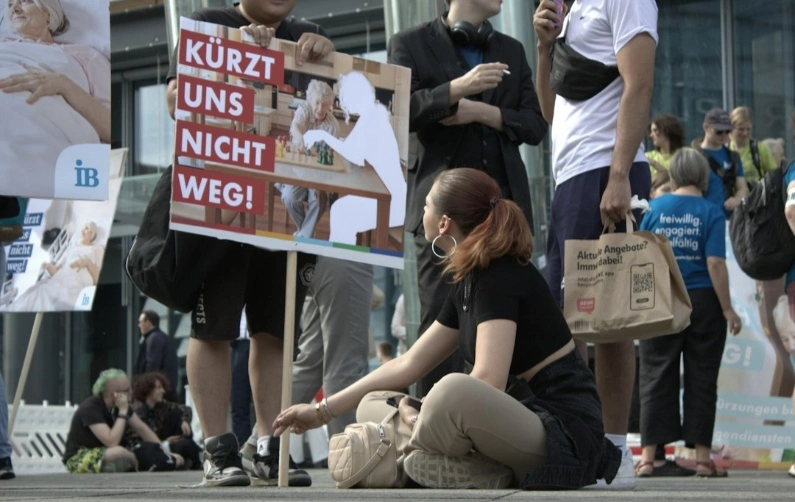
German health minister warns of potential cuts to care insurance
Section: Health
Christine Lagarde has announced she will step down as President of the European Central Bank (ECB) on February 7, 2027, cutting her term short by several months. Lagarde's eight-year tenure was originally set to end in October 2027. The decision was communicated to the ECB's governing council and the President of the European Council, António Costa.
The early departure of Lagarde, a French national, has been the subject of speculation for months. Reports suggest that she may be considering a transition to a role at the World Economic Forum. While the precise reasons for Lagarde's decision are not publicly confirmed, a source familiar with the matter told Reuters that her decision was influenced by a desire to engage more freely in French politics.
With Lagarde's impending exit, European Union member states using the euro currency, numbering 21, are tasked with appointing her successor sooner than anticipated. This provides an opportunity for outgoing French President Emmanuel Macron and German Chancellor Friedrich Merz to influence the appointment before France's presidential election. The election, scheduled for April 2027, could see a rise in euro-skeptic sentiments should Marine Le Pen's party gain momentum, complicating the ECB leadership transition.
António Costa stated that the process to select a new ECB President will begin promptly. The selection is a significant decision for the Eurozone as the ECB plays a critical role in shaping monetary policy across the region. Analysts will be watching closely to see how this leadership change might impact economic policy amid ongoing financial challenges.
Following her appointment to the ECB in November 2019, Lagarde has been a prominent figure in European and global economic circles. Her leadership coincided with tumultuous periods, including the COVID-19 pandemic, which demanded unprecedented monetary measures to stabilize the Eurozone economy.
The ECB under Lagarde's tenure pursued expansive monetary policies, including maintaining low interest rates and implementing asset purchase programs, aimed at fostering economic recovery and managing inflation rates. Lagarde's approach aligned with her predecessor Mario Draghi's policies, continuing efforts to boost economic growth in the face of external shocks and internal structural challenges.
The potential shift in leadership comes amidst varying economic priorities and concerns within the Eurozone, with Northern EU countries more cautious about monetary easing compared to their Southern counterparts, who favor more robust stimulus measures.
The timing of the leadership change adds an element of uncertainty as the ECB is poised to address rising inflationary pressures, driven by energy price hikes and supply chain disruptions. Any change in leadership could influence market perceptions and the ECB's policy direction.
In light of recent financial reports, the focus on the ECB's next steps includes navigating post-pandemic recovery and sustaining economic momentum. Stakeholders within the Eurozone will be keen to know how the new leadership will balance inflation control with economic support.
Lagarde has played an influential role beyond monetary policy, emphasizing issues such as climate change and digital currency innovation, areas that the ECB has increasingly prioritized under her leadership. Her tenure has been marked by advocating for sustainable finance and integrating gender diversity within financial institutions.
While there has been no official announcement regarding her future role, Lagarde's exit grants her the possibility to have a more active voice in public affairs, potentially shifting to influential economic platforms or roles that can leverage her experience and insights.
The forthcoming decision on Lagarde's successor will be watched closely, as it bears implications not only for monetary policy but also for the broader political dynamics within the EU. The ECB's actions under new leadership could influence how the economic bloc deals with forthcoming challenges and opportunities in the global financial landscape.
Lagarde's looming departure also sets the stage for strategic decision-making within the ECB itself, with potential changes in policy focus likely depending on the incoming president's stance and economic priorities.
Section: Health

Section: News
Section: News

Section: Travel

Section: Business

Section: Science

Section: News

Section: News

Section: News

Section: Travel
Both private Health Insurance in Germany and public insurance, is often complicated to navigate, not to mention expensive. As an expat, you are required to navigate this landscape within weeks of arriving, so check our FAQ on PKV. For our guide on resources and access to agents who can give you a competitive quote, try our PKV Calculator.
Germany is famous for its medical expertise and extensive number of hospitals and clinics. See this comprehensive directory of hospitals and clinics across the country, complete with links to their websites, addresses, contact info, and specializations/services.
Didn't manage to get a ticket for Linkin Park? Or still not enough after the concert? Join us at CRASH on June 12th for our "IN THE END" Linkin Park Special + CORE NIGHT.All night long, we'll be playing Linkin Park's music, along with Nu Metal, Metalcore, and Alternative Rock from bands such as Limp...



No comments yet. Be the first to comment!