Inside "The Ninety-Nine Percent": The Full Story Behind Matières Fécales' Most Ambitious Show Yet
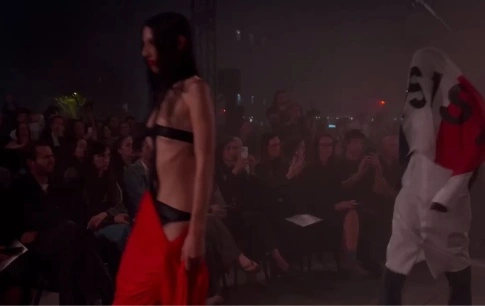 Before 99 models walked across Place de la République, Steven Raj Bhaskaran was an 11-year-old sharing a single mattress with his mother and sister. He told W Magazine that memory became the cornerstone of the collection he and Hannah Rose Dalton would eventually stage in one of Paris's most politically charged public squares. Understanding Matières Fécales' Spring/Summer 2027 show means understanding that the distance between those two images, the childhood bedroom and the monumental square, is the entire point.
A Two-Chapter Story
This season did not arrive on its own. It is the second half of a narrative Dalton and Bhaskaran began last season with a collection built around the ultra-wealthy, which the brand titled The One Percent. This time, the lens flipped entirely. Titled The Ninety-Nine Percent, the show was conceived as a direct response, moving from a critique of elites to a tribute to everyone standing outside that bracket. Bhaskaran told W Magazine that freedom was the organizing idea behind the collection, adding that the question of whether freedom is even possible for the people he grew up around stayed with him throughout the design process.
Why 99, Specifically
The number 99 was not a stylistic flourish. According to Numéro, the show brought together, in the brand's own words, ninety-nine models of color and ninety-nine looks by a designer of color, over roughly 35 minutes. Bhaskaran has described the casting itself as a reflection of the people he grew up with in social housing in Montreal, among immigrant families and working-class communities, rather than a creative decision made independently of the people it represents. Several of the models were, by the brand's own account, people from Bhaskaran's own life rather than professional casting alone.
Why Place de la République
The choice of venue carried its own argument. Place de la République has anchored French public protest for generations, from its role after the November 2015 Paris attacks to the Nuit Debout occupation that began there in 2016, sitting beneath the 19th-century monument to the Republic topped by the statue of Marianne. Bhaskaran described the square to Numéro as a sacred place in the city for expressing opinions and celebrating togetherness, calling it a place of revolution. He went further in comments quoted by FashionNetwork, saying it felt fitting that the first fashion show ever held there was organized by immigrants, calling it a symbol of the progressive future the city is working toward. According to StyleGuru, the show was in fact the first runway presentation in the square's history.
What the Collection Actually Looked Like
Reviewers who attended described a show built in distinct movements rather than a single continuous mood. WWD reported that clouds of smoke and strobe lighting surrounded the statue of Marianne as silhouettes evoking masked demonstrators emerged, built from leather outerwear, shredded denim and logo sweatshirts, with spiked faux piercings worn across some models' faces and arms. According to Vanity Teen, the palette moved from black through shades of red, orange, pink and light blue before returning to white around look 40, a moment multiple outlets described as one of the show's most intimate. The collection reportedly closed on a section titled Gods. A collaboration with Christian Lacroix produced a set of towering heels, which Rihanna wore to attend the show, according to W Magazine's reporting.
The Contradiction Critics Keep Raising
Not every response treated the show as an unqualified success, and the sharpest criticism centers on a tension the designers themselves have acknowledged. WWD noted plainly that the brand is aware of the paradox in staging a show about poverty and disenfranchisement from within the luxury fashion system, on garments priced accordingly. nss magazine pushed further, arguing the collection's message ultimately overshadowed its design execution, and citing commentary from the account @insidethemood describing the show as one that spoke of resistance and marginalization from behind a velvet rope. The underlying question, posed across several reviews, is whether a brand operating inside haute couture pricing can meaningfully represent the 99 percent it says it's honoring, or whether the gesture functions more as spectacle than solidarity.
The Commercial Reality Behind the Statement
Whatever the ideological debate, the show's commercial trajectory has not suffered for it. Bhaskaran told WWD that wholesale orders tripled following the brand's previous show, framing that growth as proof that a label can be bold, honest and commercially successful at the same time. The brand continues to operate with backing from the Dover Street Market Paris incubator, the relationship that first brought Matières Fécales into a formal retail and production structure after Dover Street Market co-founder Adrian Joffe discovered the designers in 2024.
Where This Leaves the Brand
Two seasons in, Matières Fécales has built its reputation on staging fashion as social argument rather than seasonal trend, using real family members on the runway, true personal history in its show notes, and settings chosen for their civic weight rather than their photogenic value. Whether The Ninety-Nine Percent resolves the contradiction critics have raised, or simply makes the contradiction itself the subject, is likely to remain the central conversation around this brand for as long as it keeps building collections this way.
Sources: WWD; nss magazine; Vanity Teen; FashionNetwork; Numéro; Metal Magazine; W Magazine; StyleGuru.
Photo by Rime Oualhaji