Inside Matières Fécales' Show at Place de la République
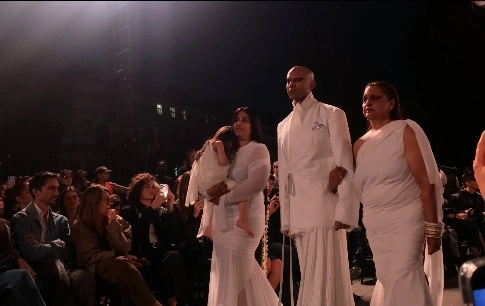 Hannah Mones attended Matières Fécales' Spring/Summer 2027 show in person on the evening of Monday, September 28, 2026, staged at Place de la République, a square known in France for protest marches rather than couture.
A Square That Doesn't Usually Do This
Place de la République has hosted French political demonstrations for generations, and holding a runway show there instead of one of Paris's usual fashion venues said something before a single model walked. Arriving guests were each handed a printed booklet featuring Steven Raj Bhaskaran, one half of the brand's founding pair, writing about his own journey chasing freedom while growing up poor in Montreal. According to the booklet, the choice of venue was deliberate. Bhaskaran called the square sacred ground for the city to voice its opinions, and said he found it fitting that immigrants like him were staging the first fashion show ever held there. Last year's debut collection was built around the theme of the 1 percent; this season flips that lens entirely, toward the 99 percent.
The Show Itself
The collection was staged in three parts, titled FAMILY, TRIBE and GODS. It opened with a pregnant model in a white, one-shoulder draped gown, a matching veil trailing off one shoulder, her hand resting on her belly as she walked, an image that echoes his mother carrying her children through hardship, according to his notes. A stream of white looks followed, tracing his own religious upbringing, which moved from Hinduism to Christianity to Islam after his mother remarried, and later to Mormonism until he was 14, when he built his own faith. Running a little over half an hour and closing at 20:38, the show moved unevenly on purpose, slow and near-silent stretches broken up by sudden loud music, the lighting cutting on and off rather than staying steady, sometimes dropping the runway into darkness before flooding back in pink, blue, red, white, black or grey. Smoke moved through several segments too. Models walked faster during the loud stretches and slower when the sound dropped out.
Color shifted hardest in the TRIBE section, military tulle tweed sets and decaying lamb leather capes worn like armor. Gold gloves replaced the red palm gloves from last season's collection, a shift Bhaskaran describes as a nod to the talents of minorities too often exploited by the wealthy. Three models walked in sequence dressed in white, blue and red, the same three colors as the French flag. GODS closed the show on its most labor-intensive pieces, cotton woven by hand by artisans at Cabes Gie in Burkina Faso, and sarees hand embroidered by Tilfi in Varanasi, India, reworked into decayed, 1950s-style ball gowns. One look paired a pale pink and gold sari, its train long enough to drag across the ground, with white opera gloves. Flip-flop curved heels made in collaboration with Christian Louboutin appeared throughout, a nod, according to his notes, to a designer of color who came from the same kind of background he did.
Bhaskaran walked the runway himself partway through, flanked by two women dressed in white, his mother and his sister, the latter carrying a small child in her arms.
The finale came in two parts, and both referenced the brand's own history. In the first, a model in a cream suit carried another man across his shoulders, dressed in black, face down, a banknote covering his face, echoing the billionaire figures carried through last season's show, The One Percent. The closing look repeated the image, this time with two men. A model in a floor length metallic gold gown carried them both, dressed in black suits, one in a blonde wig, banknotes covering their faces. It was the starkest image of the night. Bhaskaran spells it out plainly in the booklet, writing that diversity is power and framing the image as a call to dismantle the structures that keep it suppressed.
The Room Was Watching Rihanna
Rihanna arrived a few minutes before 8pm and took her seat beside Rick Owens and his wife, Michèle Lamy. For most of the show, more eyes stayed on the front row than on the runway. At one point she walked directly past me on her way to her seat, close enough that there was no question it was her. After the show ended, she stayed for several minutes for photos, including with British content creator and television presenter Nikki Lilly.
What Stayed With Me
Matières Fécales wasn't a brand I knew going in, and its aesthetic isn't naturally what I gravitate toward. I left having changed my mind, and the booklet is a large part of why.
Bhaskaran writes about being a child in a one-bedroom apartment in Montreal, sharing a single mattress with his mother and sister. While his mother got ready to clean other families' apartments nearby for extra income, and his sister put on her uniform to work an illegal shift at KFC at 14, he sat by the window and sketched the two of them in imagined couture gowns, using pencils he'd taken from school. He has written that those drawings were his way of designing a life without struggle for the two of them, a life he didn't think could exist anywhere except on paper.
Watching his mother and sister actually walk that runway in white, dressed in the kind of clothes an 11-year-old once had to invent in secret, is not something a press release can manufacture. Whatever else gets said about this show, that part of it was real, and it's the part I haven't stopped thinking about since.
Sources: Matières Fécales show notes, distributed to guests at the September 28 presentation.
Photo by Hannah Mones